
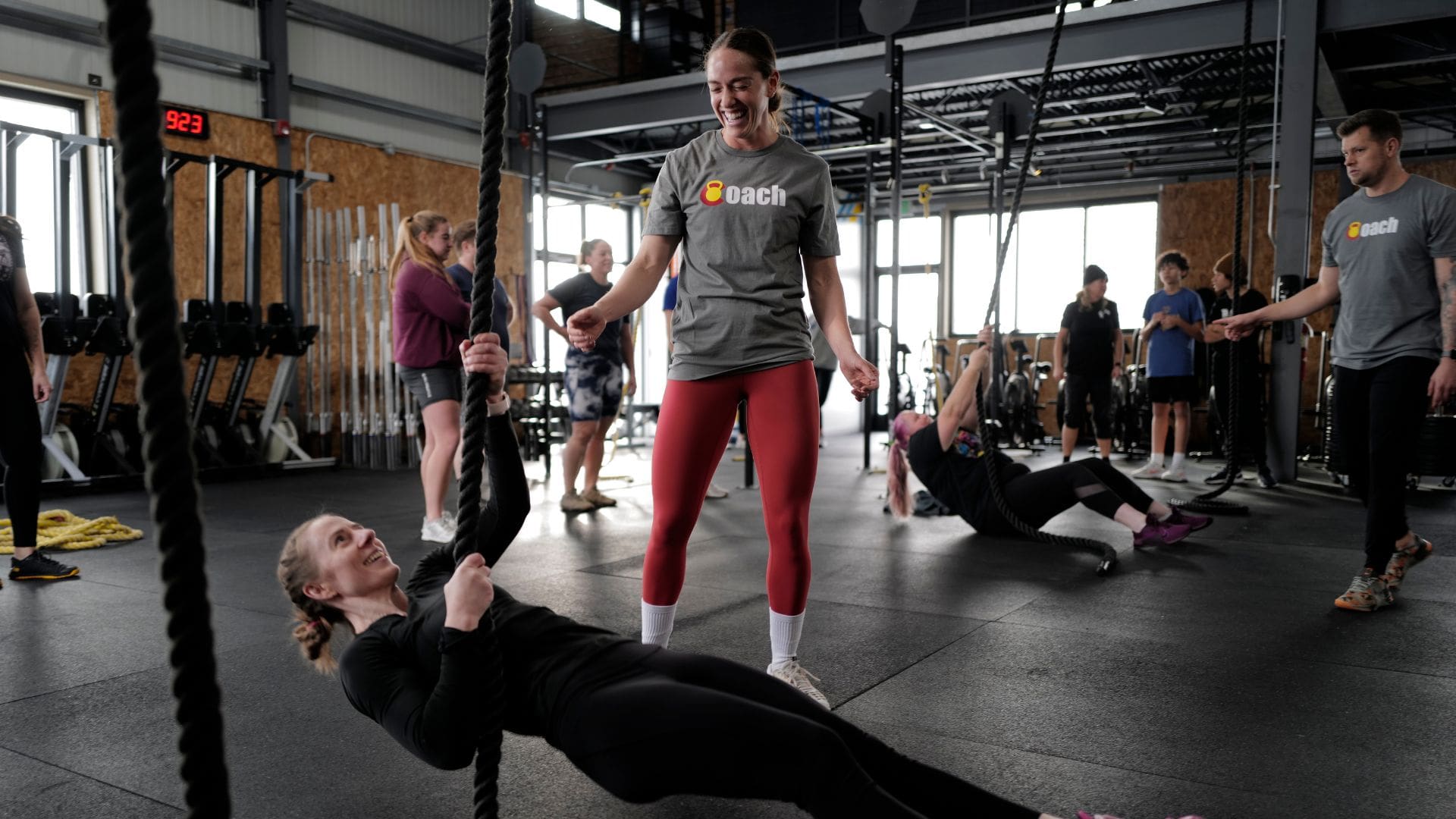
You’ve finally decided to do something about your fitness. Maybe you’ve seen a few friends posting about their CrossFit workouts and started wondering if you could do it too. Then the voices kick in. “I don’t have time to spend two hours in the gym.” “I can’t do those moves.” “I’m too out of shape for that.” “I’ll be too tired with all the running around I already do.”
Those thoughts are normal. Most parents have them. But a lot of those assumptions are based on a version of CrossFit that doesn’t match what actually happens when you walk into a well-run gym.
Why Most Parents Assume CrossFit Won’t Work for Them
The mental image most people carry is of elite athletes doing impossible things for hours at a time. That picture makes it easy to talk yourself out of even trying. Add in a school pickup schedule, a full workday, and whatever else is on the calendar, and it starts to feel like CrossFit is something other people do, people with more time or fewer responsibilities.
The reality is more straightforward than that. The concern isn’t really about CrossFit being too hard. It’s about whether it can actually fit into a life that’s already full.
How Long a CrossFit Session Actually Takes
A well-run CrossFit class is 60 minutes from start to finish. That’s the whole thing: warmup, instruction, the workout, and cooldown. It’s designed that way specifically because most people don’t have two hours to spare.
Life happens, too. You might be a few minutes late because the drop-off line backed up. You might need to leave a few minutes early to make pickup. That’s fine. Coaches and classmates will get you caught up if you come in late, and if you need to slip out early, someone will make sure your equipment gets cleaned up. The goal is for you to be there investing in your health, not to be there perfectly.
That said, try to plan for the full hour and aim to arrive on time. If you know you’ll be more than ten minutes late or need to leave more than ten minutes early, it’s worth checking whether a different class time works better that day. Something is always better than nothing, but a little planning goes a long way.
The One Scheduling Shift That Makes CrossFit Stick
The biggest factor in showing up consistently isn’t motivation. It’s picking the right class time from the start.
A lot of people come in fired up and sign up for a 5am or 6am class. That’s great if early mornings are already part of your routine. But if you’ve never been an early riser, setting that as your starting point can backfire quickly. Miss a few early classes because you couldn’t drag yourself out of bed, and it starts to feel like failure before you’ve really begun.
Start with a class you know you can actually make. A lunchtime session or an after-work class might build momentum more reliably than an ambitious early slot you’re not ready for yet. Once you’ve picked a time, do two things: put it on your calendar like any other appointment you can’t skip, and account for your commute. Even five minutes matters. If you’ve built in travel time, you won’t arrive rushed and already stressed before the workout starts.
Finding the Gaps: Mapping Workouts Around School Runs and Work Hours
With work, commute, school pickup, and sports drop-off all competing for the same hours, no single class time will work every day. That’s expected. Some weeks you’ll make the early class. Other weeks it’ll be the after-work session. The class schedule at CrossFit ELM is built around common work and family patterns, so there are options across the day rather than just one or two slots.
One thing that helps a lot of parents is flexibility in how they think about the schedule. If Tuesday’s 4pm doesn’t work because practice got moved, the 5:30pm might. If neither works, there’s an at-home version of the workout available through the app.
And if the commute is tight and the kids need to come with you, bring them. There’s a safe area where they can play or work on homework while you train. Beyond the practical side, there’s something worth noting: your kids see you making time for your health. That matters. A lot of the kids who come in with parents end up wanting to do what they see mom or dad doing in class.
What a Realistic First Week of CrossFit Looks Like for a Parent
If you’re new to CrossFit, the first week or two will probably feel exciting. You’ll want to come every day. What you won’t know yet is how tired you’re going to be, not just physically, but in terms of adjusting to a new schedule on top of everything else.
Start with three or four days. Pick days you know you can make, with enough space between them to recover and adapt. Use those first weeks to figure out the practical stuff too: how long does your commute actually take at that time of day? Does the pickup line slow you down more than expected? Are the kids cooperating or is there a meltdown every Tuesday?
Those details are part of the learning curve. Building a new habit isn’t just about the workout. It’s about learning how the whole thing fits into your actual day, not an idealized version of it.
What to Do When the Week Falls Apart
At some point, a week will go completely sideways. A kid gets sick. A meeting runs long. Traffic is a disaster and you miss your class entirely. It happens to everyone.
When it does, the at-home versions of the workouts are there. Most of them need little or no equipment. If even that feels like too much, go for a 15 to 30 minute walk or run. Do something. The point isn’t to hit a perfect attendance record. It’s to stay committed to the habit of investing in your health, even when the plan falls apart.
You stay on track by being willing to shift, not by being rigid. A missed class isn’t a failure. Deciding the whole week is a write-off because of one missed class is where things actually go wrong.
How CrossFit ELM Is Set Up for Parents Who Can’t Commit to a Fixed Schedule
The class schedule at CrossFit ELM is built with flexibility in mind. Can’t make the 4pm you planned on? Check if the next class works. Can’t make it in at all that day? Open the app and do the at-home version. Kids need to come with you to make the timing work? Bring them in.
A lot of the coaches here are parents. They understand what it actually takes to get through the door on a Tuesday when everything has gone sideways. The goal isn’t a perfect schedule. It’s a sustainable one.
If you’re not sure how to make it fit, talk to a coach. That’s what they’re there for. Bring your actual schedule, the real one with all the complications, and work out a plan that has a reasonable chance of holding up past the first two weeks.
Your health is worth the time. Even if that means a different class than you planned, a workout done at home, or a conversation about how to make it all fit. Start where you are, with what you actually have available, and build from there.


